Industrial welding services are essential for OEMs producing heavy equipment, transportation systems, industrial machinery, structural assemblies, and fabricated components.
Choosing the best welding method depends on several factors, including material type, component thickness, production volume, cosmetic requirements, and structural performance expectations.
This guide explains common welding processes, compares MIG vs TIG welding, and outlines how OEMs can select the right approach for their industrial fabrication projects.
Why Welding Process Selection Matters
Welding is more than joining metal components together. In industrial manufacturing, welding quality directly impacts product reliability, safety, manufacturability, and assembly performance.
The wrong welding process can lead to:
- Excessive distortion
- Weak weld penetration
- Poor cosmetic appearance
- Slower production cycles
- Increased rework
- Higher manufacturing costs
OEMs working with fabricated steel assemblies, weldments, and structural components should evaluate welding processes early in the design phase to improve production efficiency and reduce downstream issues.
Partnering with an experienced industrial welding services provider helps ensure welding methods align with both engineering requirements and manufacturing goals.
Common Industrial Welding Processes
Several welding processes are commonly used in industrial metal fabrication and structural welding services. Each offers different advantages depending on the application.
MIG Welding
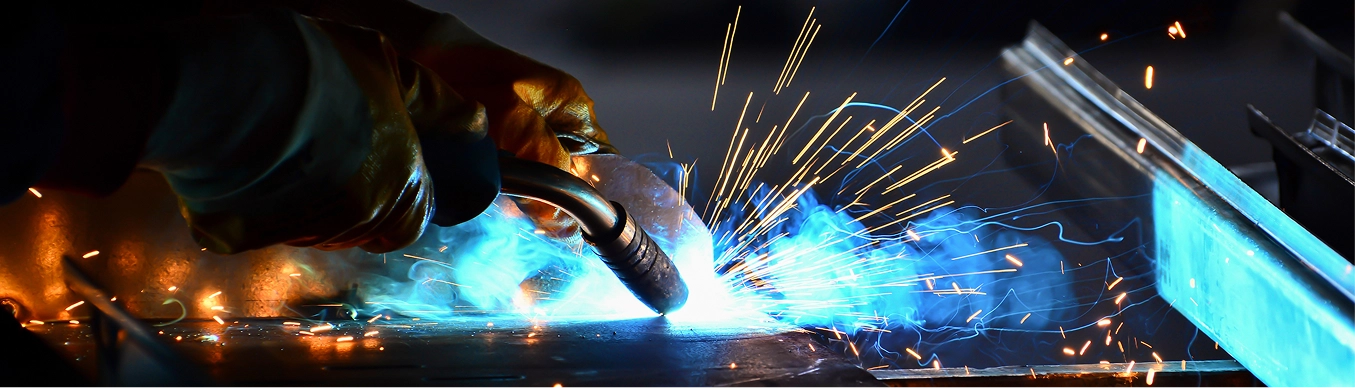
MIG welding, also known as Gas Metal Arc Welding (GMAW), is one of the most widely used welding processes in industrial manufacturing.
MIG welding uses a continuously fed wire electrode and shielding gas to create the weld, and because of its speed and efficiency, MIG welding is often preferred for high-volume OEM production environments.
Advantages of MIG welding include:
- High production speed
- Strong weld penetration
- Efficient automation capability
- Lower labor costs
- Consistent weld quality
MIG welding is commonly used for:
- Heavy equipment fabrication
- Structural steel components
- Transportation equipment
- Large weldments
- Production manufacturing
TIG Welding
TIG welding, or Gas Tungsten Arc Welding (GTAW), uses a non-consumable tungsten electrode to create precise, high-quality welds.
Compared to MIG welding, TIG welding offers greater control and cleaner weld appearance, but it is typically slower and more labor-intensive.
TIG welding is commonly selected for:
- Thin materials
- Precision components
- Stainless steel fabrication
- Aluminum fabrication
- Cosmetic weld applications
When comparing MIG vs TIG welding, TIG generally provides higher precision and appearance quality, while MIG offers better production efficiency and scalability.
OEMs often use TIG welding when weld aesthetics, tight tolerances, or specialized materials are priorities.
Flux-Cored Arc Welding
Flux-Cored Arc Welding (FCAW) is similar to MIG welding but uses a tubular wire filled with flux material instead of relying entirely on shielding gas.
FCAW is commonly used in heavy industrial applications because it performs well on thicker materials and outdoor fabrication environments.
Applications include:
- Heavy structural fabrication
- Construction equipment
- Large steel assemblies
- Structural welding services
Flux-cored welding can improve deposition rates and productivity for large fabricated components.
Robotic Welding
Many industrial welding services providers now integrate robotic welding systems into production environments.
Robotic welding improves:
- Repeatability
- Weld consistency
- Production speed
- Labor efficiency
- Dimensional accuracy
For OEMs with high-volume production requirements, robotic welding can reduce manufacturing variability while supporting scalable production.
Summary Chart
| Process | Best Use | Strengths | Tradeoffs | Typical Applications |
| MIG (GMAW) | High-volume production | Fast, strong, automation-friendly | Less precise on thin materials | Heavy equipment, structural steel, transportation components |
| TIG (GTAW) | Precision & cosmetic welds | Clean appearance, high control | Slower, higher labor cost | Stainless steel, aluminum, precision assemblies |
| Flux-Cored (FCAW) | Heavy structural fabrication | High deposition, outdoor capable | More cleanup required | Construction equipment, thick steel assemblies |
| Robotic Welding | Repeatable OEM production | Consistent, scalable, efficient | Higher setup investment | Automated weldments, production fabrication |
| Structural Welding | Load-bearing assemblies | High strength, code-compliant | Requires strict QA/QC | Frames, machinery, fabricated structures |
Learn more about our fabrication and welding capabilities.
Factors That Influence Welding Process Selection
Selecting the right welding process requires balancing engineering requirements with manufacturing efficiency.
Important considerations include:
Material Type
Different materials require different welding methods. Carbon steel, stainless steel, aluminum, and abrasion-resistant plates each have unique welding characteristics.
Material Thickness
Thin materials often require precision processes like TIG welding, while thicker structural components may benefit from MIG or flux-cored welding.
Production Volume
High-volume OEM manufacturing environments often prioritize welding processes that support automation and faster cycle times.
Cosmetic Requirements
Visible components or customer-facing products may require cleaner weld appearance and minimal post-processing.
Structural Performance
Structural welding services must meet strength, fatigue resistance, and inspection requirements depending on the application.
Early collaboration between engineering teams and fabrication specialists helps identify the most efficient and cost-effective welding solution.
The Importance of Welding Expertise
Even the best welding process depends on proper execution. Weld quality is influenced by:
- Weld procedure development
- Joint preparation
- Heat input control
- Fixturing
- Welder skill
- Inspection standards
Experienced industrial welding services providers maintain certified welding procedures, qualified weld personnel, and quality control systems to ensure reliable production results.
Choosing the Right Partner For Your Industrial Welding Services
The right industrial welding services provider can help improve manufacturability, reduce production challenges, maintain quality standards, and support scalable manufacturing programs.
If you are evaluating welding solutions for fabricated assemblies or structural components, contact our team to discuss your welding and fabrication requirements with an experienced manufacturing team.