Heavy-gauge components must withstand demanding operating conditions while meeting the dimensional requirements of the larger assembly. For OEMs and industrial manufacturers, producing these parts efficiently requires a cutting process suited to thick material, complex profiles, and repeat production.
CNC plasma cutting offers a practical combination of speed, accuracy, and material capacity. The process can produce plates, brackets, structural components, equipment parts, and weldment details from electrically conductive metals. With the right equipment and process controls, it can also reduce downstream labor and help manufacturers move efficiently from raw plate to production-ready fabrication.
How CNC Plasma Cutting Works
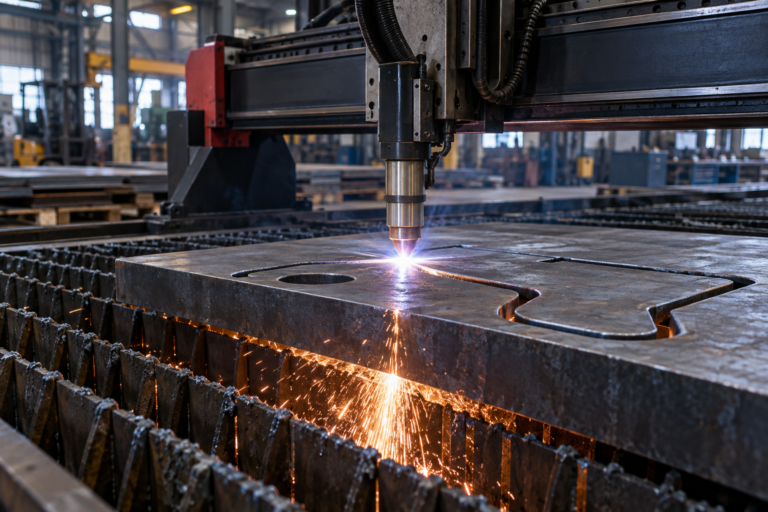
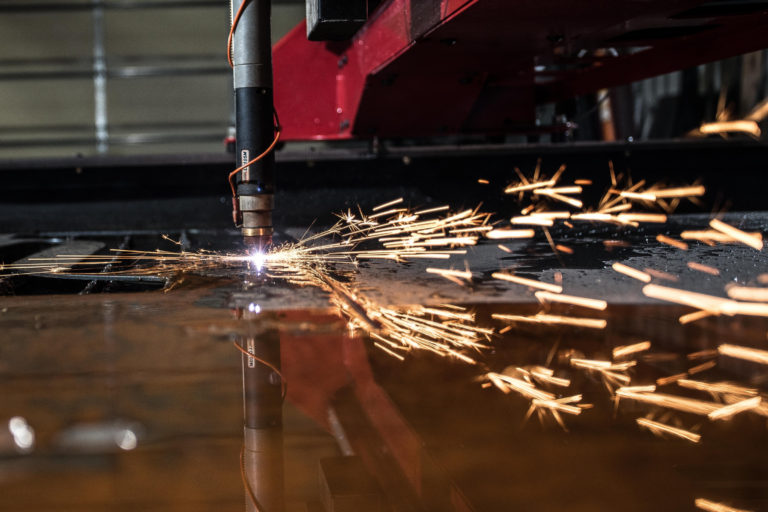
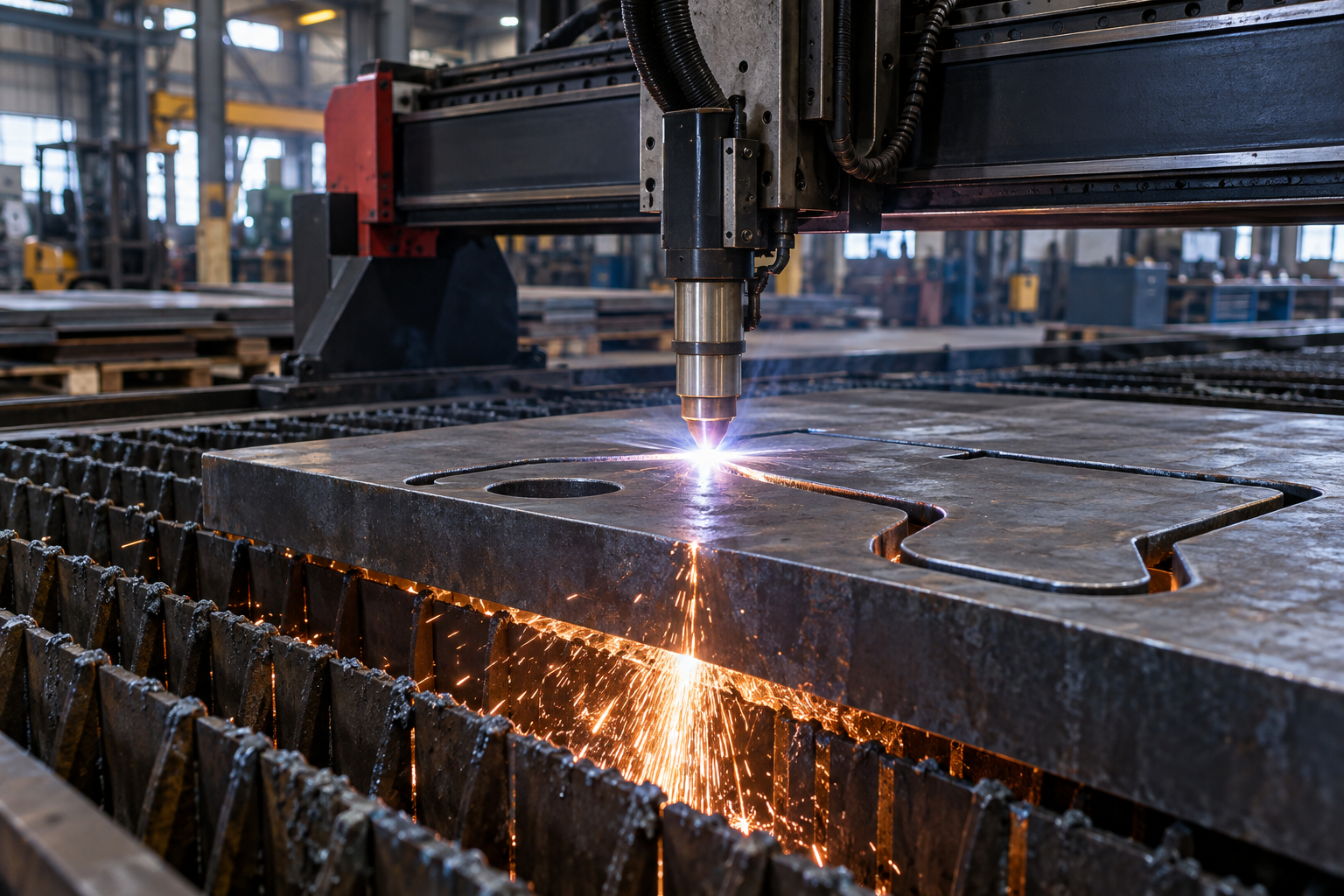
Plasma cutting uses a high-velocity jet of ionized gas to melt and remove material along a programmed cut path. The plasma arc passes through the workpiece, while the gas stream clears molten metal from the kerf.
In a CNC system, computer numerical controls direct the torch according to a digital part file. Automated motion allows the machine to reproduce profiles, holes, slots, and other features across multiple parts with greater consistency than manual cutting.
CNC programming also enables fabricators to nest several components on one plate. Effective nesting improves material utilization, limits scrap, and can reduce the cost per part, especially across production quantities.
Why Plasma Cutting Works Well for Heavy-Gauge Metal
Heavy plates can challenge cutting processes that were designed primarily for thin sheets. CNC plasma cutting is particularly useful for medium- and heavy-gauge conductive metals because it combines substantial cutting capacity with relatively fast processing speeds.
Common materials include:
- Carbon steel
- Stainless steel
- Aluminum
- Abrasion-resistant steel
- Galvanized steel
- Other electrically conductive alloys
When plasma cutting steel, the machine’s power level, gas selection, travel speed, torch height, and consumable condition all influence the finished edge. Experienced operators adjust these variables to control dross, bevel, kerf width, and heat input.
The process is frequently used for components such as base plates, mounting plates, gussets, brackets, frame members, flanges, wear parts, and structural details. These parts may be supplied as cut blanks or transferred to forming, machining, welding, and finishing operations.
The Advantages of High-Definition Plasma Cutting
High-definition plasma cutting uses a more focused arc, refined gas delivery, advanced torch technology, and precise motion control to improve cut quality. Compared with conventional plasma cutting, it can produce a narrower kerf, less edge bevel, reduced dross, and more consistent contours.
These improvements can be valuable when parts must fit accurately into fabricated assemblies. Cleaner profiles may require less grinding or edge preparation, while better hole quality can reduce the amount of drilling or machining needed after cutting.
High-definition systems can also improve consistency around corners and small features through automated torch-height control and optimized cutting parameters. Results still depend on material type, thickness, feature geometry, and tolerance requirements, so each part should be evaluated based on its function.
CNC Plasma Cutting Compared with Other Cutting Processes
Selecting a process requires more than choosing the technology with the tightest possible tolerance. Engineers and sourcing teams should consider material thickness, part size, edge requirements, production volume, secondary operations, lead time, and total cost.
Plasma Cutting vs. Laser Cutting
Laser cutting can provide excellent accuracy and edge quality, particularly on thinner materials and parts with fine features. CNC plasma cutting is often more economical and productive for medium-to-thick plates, especially when the component does not require laser-level tolerances.
Plasma Cutting vs. Oxy-Fuel Cutting
Oxy-fuel can cut very thick carbon steel, but it is generally slower and introduces more heat into the workpiece. It is also limited primarily to ferrous materials. Metal plasma cutting works with carbon steel, stainless steel, and aluminum while typically producing a narrower heat-affected zone.
Plasma Cutting vs. Waterjet Cutting
Waterjet cutting avoids a heat-affected zone and can process many metal and nonmetal materials. However, it is often slower and more expensive for thick, conductive metal components. Plasma may provide a better balance of speed and cost when some thermal influence is acceptable.
4 Design Considerations for Using Plasma Cutting for Heavy-Gauge Parts
Part geometry and documentation have a direct effect on cut quality, manufacturing cost, and lead time. Engineers should address several factors before releasing a design for custom plasma cutting.
1. Use Practical Tolerances
Applying tight tolerances to every dimension can increase cost without improving performance. Tolerances should reflect the needs of the completed assembly. Critical bores, mating surfaces, or precision features may require secondary CNC machining.
2. Account for Kerf and Edge Condition
The plasma arc removes a narrow band of material called the kerf. CNC programming compensates for this width, but designers should still avoid features that are too small for the plate thickness or selected process.
Drawings should also identify expectations for dross removal, deburring, weld preparation, and cosmetic appearance. Clear requirements help the supplier select appropriate cutting and finishing steps.
3. Consider Heat Input and Distortion
Although plasma cutting is relatively fast, it remains a thermal process. Long cuts, narrow sections, and closely spaced features may react to heat. Part sequencing, nesting, torch settings, and plate support can help control distortion.
4. Plan for Downstream Fabrication
A cut component is often one stage of a larger manufacturing process. Hole placement, bend allowances, weld access, machining stock, and assembly interfaces should be reviewed together. Involving the fabricator early can reveal opportunities to simplify the part or combine operations.
For more guidance on preparing project documentation, review what to include when requesting CNC plasma cutting services.
Applications for OEM and Industrial Manufacturing
CNC plasma cutting services support heavy-duty products across a range of industries. Agricultural and construction equipment manufacturers use plasma-cut plates for frames, mounts, guards, and attachments. Industrial machinery builders need bases, brackets, structural supports, and material-handling components. Specialty and service vehicle manufacturers may require outriggers, equipment mounts, body components, and reinforcement plates.
The process also supports welded fabrications for utilities, recycling systems, transportation equipment, and plant infrastructure. When cutting is integrated with forming, welding, machining, and assembly, buyers can source completed components instead of coordinating separate vendors for each operation.
Selecting CNC Plasma Cutting Services
A capable supplier should evaluate more than whether a part fits within the machine’s cutting envelope. Buyers should review plate capacity, high-definition equipment, material experience, nesting and programming expertise, quality controls, secondary operations, and production scheduling.
For heavy-gauge parts and fabricated components, Metal Services of Blooming Prairie offers CNC plasma cutting services for carbon steel, stainless steel, and aluminum, with plasma capacity from 10 gauge through 3-inch plate and an 8-by-20-foot cutting table.
Request a quote to discuss your drawings, material requirements, production quantities, and completed-part needs.