
Bent tube is an essential part of many industrial products. It forms structural frames, fluid-routing systems, equipment guards, handrails, vehicle components, supports, and mechanical assemblies. When these parts must fit accurately and perform reliably, the bending process requires careful control of material behavior, geometry, tooling, and production variables.
Custom tube bending gives OEMs the flexibility to produce components around the exact needs of an application. A well-designed bent tube can reduce part count, eliminate welded joints, simplify assembly, and create a strong, continuous structure. Achieving those benefits starts with matching the design to an appropriate material and bending process.
What Is Custom Tube Bending?
Custom tube bending is the controlled forming of round, square, rectangular, or other hollow metal profiles into specified angles and radii. The resulting part may include a single bend or several bends positioned along different planes.
Unlike standard fittings or preformed elbows, custom-bent components are manufactured according to the product’s drawings, dimensions, and performance requirements. The process can support prototypes, replacement parts, small batches, and repeat production.
Professional tube bending services use dedicated tooling and controlled equipment to create repeatable bends while limiting common defects, including:
- Wall thinning
- Wrinkling
- Flattening
- Kinking
- Cracking
- Springback
- Dimensional variation
The degree of control required depends on the tube size, wall thickness, bend radius, material, part geometry, and intended use.
Pipe Bending vs. Tube Bending
The terms pipe and tube are sometimes used interchangeably, but the products are generally specified differently.
Pipe is usually identified by nominal pipe size and schedule. Its primary purpose is often to carry liquids, gases, or other materials. Tube is typically specified by its exact outside diameter and wall thickness. It is widely used in structural, mechanical, and fabricated applications where external dimensions affect fit and assembly.
Both pipe bending services and tube bending services rely on many of the same forming principles. However, the tooling, measurement methods, and quality requirements must match the exact material being processed.
Clearly identifying whether a drawing calls for pipe or tube helps prevent material and dimensional errors during quoting and production.
Common Metal Tube Bending Methods
The correct bending method depends on the component’s size, shape, bend radius, appearance requirements, and production quantity.
Rotary Draw Bending
Rotary draw bending pulls the material around a fixed-radius bend die. It provides good control over bend angle and radius, making it suitable for repeatable OEM components, frames, handles, and mechanical assemblies.
A mandrel may be inserted into the tube to support the interior during bending. Mandrel bending is especially helpful for tight radii, thin walls, and applications requiring minimal flattening or wrinkling.
Roll Bending
Roll bending gradually passes the material through a series of rollers to produce large-radius curves and sweeping arcs. It is frequently used for structural components, frames, hoops, railings, and architectural shapes.
This method is better suited to broad curves than tight, localized bends.
Compression Bending
In compression bending, a moving tool wraps the material around a stationary bend die. The process can efficiently produce simple bends, although it typically provides less control over complex geometry than rotary draw bending.
The supplier should evaluate the entire component before selecting a method. A process suited to one bend may not accommodate the part’s other angles, straight sections, or spatial requirements.
Benefits of Bent Tube in OEM Product Design
Custom tube bending can improve both component performance and manufacturing efficiency.
A continuous bent tube may replace several individually cut and welded sections. Fewer joints can reduce welding labor, inspection requirements, and potential failure points. It can also improve appearance where smooth, uninterrupted contours are desirable.
Additional benefits include:
- Reduced component count
- Faster assembly
- Lower joining and finishing requirements
- Consistent geometry across production runs
- Efficient strength-to-weight performance
- Improved routing around equipment and other components
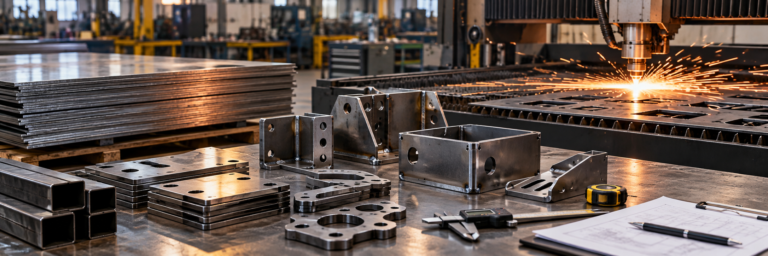
Bent members are often incorporated into larger custom metal assemblies that also require cut plates, brackets, machined details, welded joints, and hardware. Designing these elements together can improve fit and reduce rework during final assembly.
Design Factors for Precision Tube Bending
A design that looks straightforward in CAD may behave differently during forming. Several variables should be reviewed before releasing a bent-tube component for production.
Material and Wall Thickness
Carbon steel, stainless steel, aluminum, brass, and copper respond differently to forming forces. Material strength, hardness, ductility, and wall thickness influence the achievable bend radius and the risk of cracking or distortion.
Specifications should identify the complete material grade, tube dimensions, wall thickness, and any required certifications.
Centerline Radius
The centerline radius is measured from the center of the tube to the center of the bend arc. A smaller radius produces a tighter bend and places more stress on the material.
Tight-radius bending may require specialized tooling, internal support, or additional development work. If the application permits a larger radius, the part may be easier and more economical to manufacture.
Straight Length Between Bends
Bending equipment needs sufficient straight material for the tooling to grip and position the tube. Bends placed very close together can cause tooling interference or make the programmed sequence difficult to execute.
Engineers should also consider the straight length required at each end for trimming, welding, threading, flaring, or attachment.
Bend Orientation
Parts with multiple bends require clear orientation and rotation data. Even when individual angles are correct, a small rotational error between bends can prevent the component from fitting into the assembly.
Drawings should include bend locations, angles, radii, overall dimensions, and the relationship between bend planes. A 3D CAD model is particularly helpful for complex parts.
Springback
Metal tends to recover slightly after the bending force is removed. This springback varies by material, geometry, and tooling. Precision tube bending accounts for it through tooling selection, machine programming, and controlled overbending.
Quality Considerations for Repeat Production
Dimensional requirements should reflect how the component functions in the finished product. Critical characteristics may include bend angle, center-to-center dimensions, overall height and width, end position, flatness, and rotational orientation.
Buyers should also define acceptable levels of ovality, wrinkling, surface marking, and wall thinning. Cosmetic tubing may require different handling than a structural component hidden inside an equipment frame.
For repeat programs, fixtures and inspection methods help verify consistency. First-article approval can confirm that the finished component fits the mating assembly before full production begins.
Applications Across OEM and Industrial Markets
Custom tube bending supports a broad range of industrial products. Common applications include:
- Cab frames, steps, handles, and guards for specialty vehicles
- Hydraulic and process piping for industrial equipment
- Structural members for agricultural machinery
- Equipment frames, supports, and protective barriers
- Conveyance and material-handling components
- Exhaust and fluid-routing assemblies
- Railings, ladders, carts, and access systems
- Welded subassemblies for OEM products
When bent tubes require brackets, mounting plates, or other connections, coordinated welding services can help maintain assembly dimensions and reduce supplier handoffs.
What to Include in a Tube Bending RFQ
A complete RFQ allows a supplier to assess manufacturability, tooling needs, inspection requirements, and cost. Include:
- 2D drawings and 3D CAD models
- Material type and grade
- Outside dimensions and wall thickness
- Bend angles and centerline radii
- Distances and rotations between bends
- Critical tolerances
- Surface and cosmetic requirements
- End-forming or trimming needs
- Welding, machining, and finishing requirements
- Prototype and production quantities
- Required delivery schedule
Early review can identify tooling limitations, overly tight radii, insufficient straight sections, or tolerances that may require design adjustments.
Reach Out to Our Team for Help with Your Metal Tubing Projects
For OEM parts and fabricated assemblies, Metal Services of Blooming Prairie provides custom pipe and tube bending services for carbon steel, stainless steel, aluminum, brass, and copper.
Its capabilities support standard and tight-radius bends for light- to medium-duty structural and mechanical components, with additional metal fabrication services available for completed assemblies.
Request a quote to discuss your material, bend geometry, production volume, and downstream fabrication needs.